

Income and Expenditures (1755–1757): What the Expenses of Litterio Caracciolo, 10th Marquis of Brienza, Reveal
The document “Income and Expenditures 1755–1757” records the daily expenses incurred by Litterio Caracciolo, 10th Marquis of Brienza.
A ledger of income and outgoings might seem dry at first glance. In reality, these accounting entries open a window onto everyday life, luxury consumption, health, travel, and social networks linking Naples, Basilicata, and Apulia in the heart of the eighteenth century.
Context: an aristocrat between Naples and his feudal estate

From the notes emerge departures and returns, stops and detours: Brienza, Salerno, Lagonegro, Gravina, Matera, and even a journey through Apulia (Ariano, Bari, Foggia, Monte Gargano). Mobility is no mere detail: it forms part of the way a great noble household governed, consumed, and inhabited the world.
Food and luxury: between provisions, gifts, and prestige
The food-related entries combine the ordinary and the exceptional: mushrooms, pepper, pasta, tagliolini, but also Taranto oysters, eels, shellfish, and products intended “as gifts,” such as oil and caciocavalli cheeses. Food also functions as a social language: gifts, attentions to the “Lady,” refreshments, and sorbets all mark relationships and hierarchies.
Particularly revealing is the chapter on chocolate and spices: cacao, sugar, cinnamon, vanilla, manteca, even ambergris “for chocolate.” The high expenditure on these products points to luxury consumption tied to international fashions and to a courtly material culture.
Care of the body and health: apothecaries, physicians, and therapies
Among medicines and therapeutic practices appear cubeb pepper, Peru oil, plasters, “Oriental” powders against smallpox, bloodletting, and consultations. The presence of several doctors and specialists (including an English oculist) suggests a complex, costly, and ongoing management of health, especially for children and the elderly members of the household.
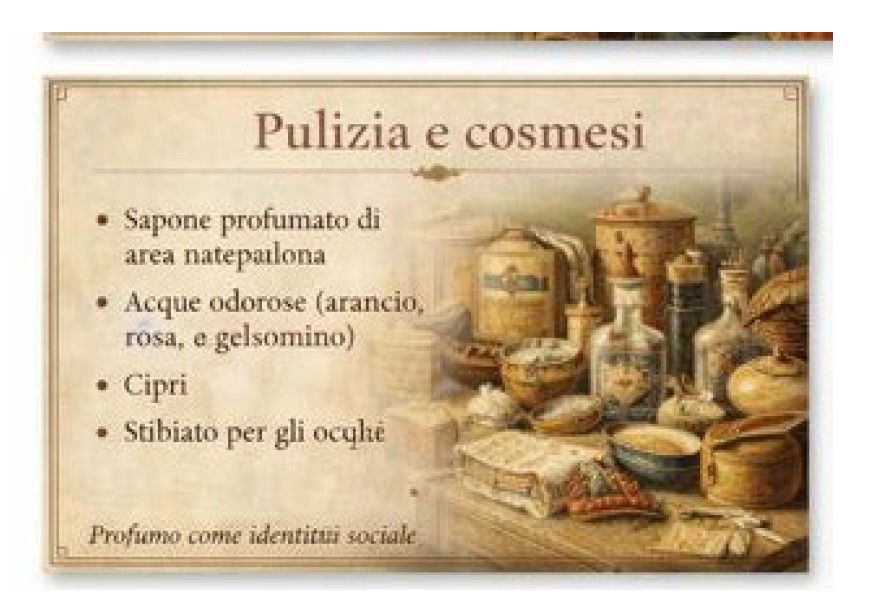
Nor are practices of well-being absent: steam baths, mineral waters, cosmetics, and toilette products. Care of the body was at once necessity, fashion, and representation.
Accessories and status: tobacco, fans, and fashionable objects
Fine tobaccos (Havana, Seville), snuff, cigars, and shagreen-covered snuffboxes are objects that speak of taste and distinction. “Chinese-style” fans, peacock feathers, jewelled buttons, walking sticks: the materiality of prestige also passed through apparently minor details.
Entertainment and culture: music, theatre, masks, and games

Expenses for comedies, theatre, musicians (Litterio was already inviting the famous players from Viggiano to perform within the castle walls, as well as an “Albanian” band and various soldier-musicians), instruments (violin, bow), masks, and games (lotto, riffa, calabresella) reveal a household that both produced and consumed entertainment.
This is an important trait: court culture did not remain confined to Naples, but also reached the feudal estate, transforming local occasions and rituals.
Brienza: administration, church, archive, and memory
Among the entries “for Brienza” appear expenses for the archive (notary, works, cabinets), furnishings and instruments (gilded chairs, harpsichord tuning), and the church (chapels, paintings, devotional objects). The archive emerges as the heart of power: to preserve documents and memory meant to govern rights, revenues, and prestige.
Travel and mobility: customs, inns, couriers, and logistics
Travel notes list customs duties, inns, stablemen, couriers, coachmen, and muleteers. Eighteenth-century mobility was costly and arduous, yet indispensable: for business, relationships, territorial control, and participation in social and religious life.
Charity, gratuities, and social networks: money as a language of power
Tips, alms, relief, gifts to employees, the poor, prisoners, and struggling families: generosity was also a form of governance. Distributing money and goods created obligations, gratitude, and loyalty. It was a concrete way of holding together both a great household and its territory.
Great events: the funerals of Teresa Pinto
The chapter on funerals (ceremonial apparatus, torches, banners, silverware, clergy, masses) shows how death became a public and political event: a staging of rank, devotion, and family memory.
Basic glossary (recurring terms)
• Tarantello: a cured product from Taranto made from the belly of tuna, often served with oil, vinegar, and oregano.• Rapè: snuff tobacco.• Manteca / mantechiglia: a fatty pomade (often scented) used for hair or body; in the context of chocolate, it may also indicate a fatty processing ingredient.• Stibiato: an eye cosmetic.• Cantemplora: a container (often tin) used to keep water or wine cool.• Bombace: wadding or tow used for lamps.• Algozzino: judicial officer or executor of legal orders.
Note on sources
This text is based on an extract from the document “Income and Expenditures 1755–1757” (an expense ledger of the Caracciolo household), preserved in the Caracciolo Archive of Brienza, now housed in the State Archive of Naples. The document was acquired by Brienza in 1799 as part of the “Archives” project.
If you have other documents, transcriptions, or references useful for contextualising the people and places mentioned, you may add them in the comments: every detail helps reconstruct more fully the material and social life of eighteenth-century Brienza.

Comments